

Spend enough time around a paint line, and you’ll hear the same conversations come up over and over again.
“Something’s off.”
“Film build isn’t where it should be.”
“We’re seeing more variation than we’d like.”
And almost immediately, the discussion turns to viscosity.
Which makes sense. Viscosity matters - a lot.
But here’s the part that doesn’t get talked about enough: How confident are we in what we’re actually seeing?
Most paint processes today are still being monitored the same way they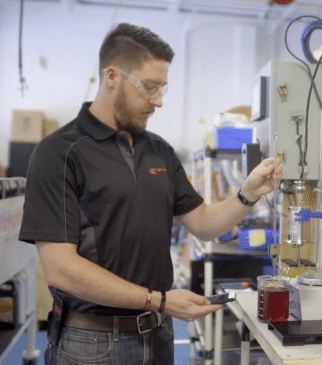 have been for decades.
A sample gets pulled.
A cup gets filled.
A number gets written down.
Maybe that happens once a shift. Maybe a few times.
And from that, we make decisions about the entire process.
But think about what that really represents.
It’s a single moment.
One snapshot.
Now compare that to what’s actually happening on the line.
The process doesn’t pause between checks. It keeps moving.
Temperature drifts throughout the day.
Material sits, circulates, and changes.
Solvent evaporates.
Conditions shift between startup, steady state, and downtime.
And all of that is happening whether we’re measuring it or not.
So we end up in this situation where we’re trying to manage a dynamic, constantly changing process…
…using static, infrequent data.
And that gap - between what’s happening and what we can see - is where a lot of problems start.
You’ll see it show up in ways that feel familiar:
A line that was running fine yesterday suddenly isn’t today.
Two shifts producing slightly different results.
A defect that appears without a clear root cause.
You go back to the data and everything looks “in spec.”
But that is because the data you have doesn’t tell the full story.
One of the biggest drivers behind all of this is temperature.
Not in a dramatic, obvious way - but in small, steady changes.
A few degrees here. A few degrees there.
And every one of those changes is quietly influencing viscosity.
Which means even if your viscosity checks look stable on paper, the actual material behavior at the point of application can be different.
And that’s really the heart of it.
In a robotic paint process, everything is built for repeatability.
The robot does the same thing every time.
The path is the same.
The speed is the same.
But the material? That’s not always the same.
If temperature and viscosity are drifting - even slightly - the robot is repeating the same motion…
…but applying a different condition of material each time.
That’s where inconsistency creeps in.
Not because anything is “wrong,” but because something isn’t being seen.
Another interesting dynamic is the difference between the lab and the line.
In the lab, everything is controlled:
Temperature is stable
Measurements are consistent
Results are repeatable
On the production floor, it’s a different story.
You have ambient swings.
Line stoppages.
Material aging.
Operator interaction.
And yet, we often assume the material is behaving the same way it did under controlled conditions.
It’s not.
When you start looking at viscosity and temperature continuously - you begin to see things that were always there, just hidden.
You see how the process actually behaves over time.
You see patterns tied to real events - drum changes, filter changes, idle periods.
You see variation between shifts, between days, even within the same run.
And in many cases, what looked stable before… isn’t nearly as stable as it seemed.
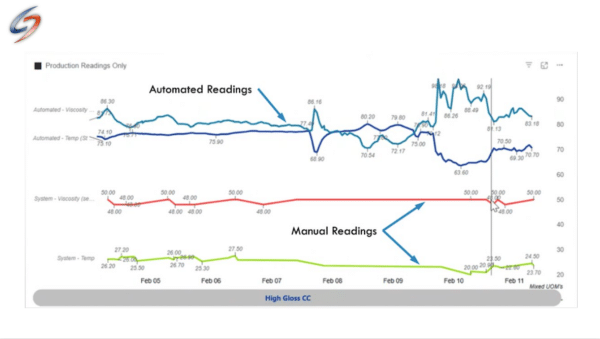
The image and data shown here were captured during a collaborative test conducted in partnership with PPG Automotive Coatings #AiMSmartPaintline. Working alongside their team allowed us to validate performance in a real production environment and generate meaningful, high-resolution process insights.
That’s when things start to click.
Not because you’ve added complexity, but because you’ve removed uncertainty.
At the end of the day, most paint teams aren’t struggling because they don’t care about the process.
They’re struggling because they don’t have full visibility into it.
They’re doing the best they can with the data they have.
But if the data only shows you a few moments in time,
you’re only seeing a fraction of the story.
And more often than not,
the variation you’re trying to control…
…is happening in the spaces between those moments.
That’s the part worth paying attention to.
Helpful Links & Resources